
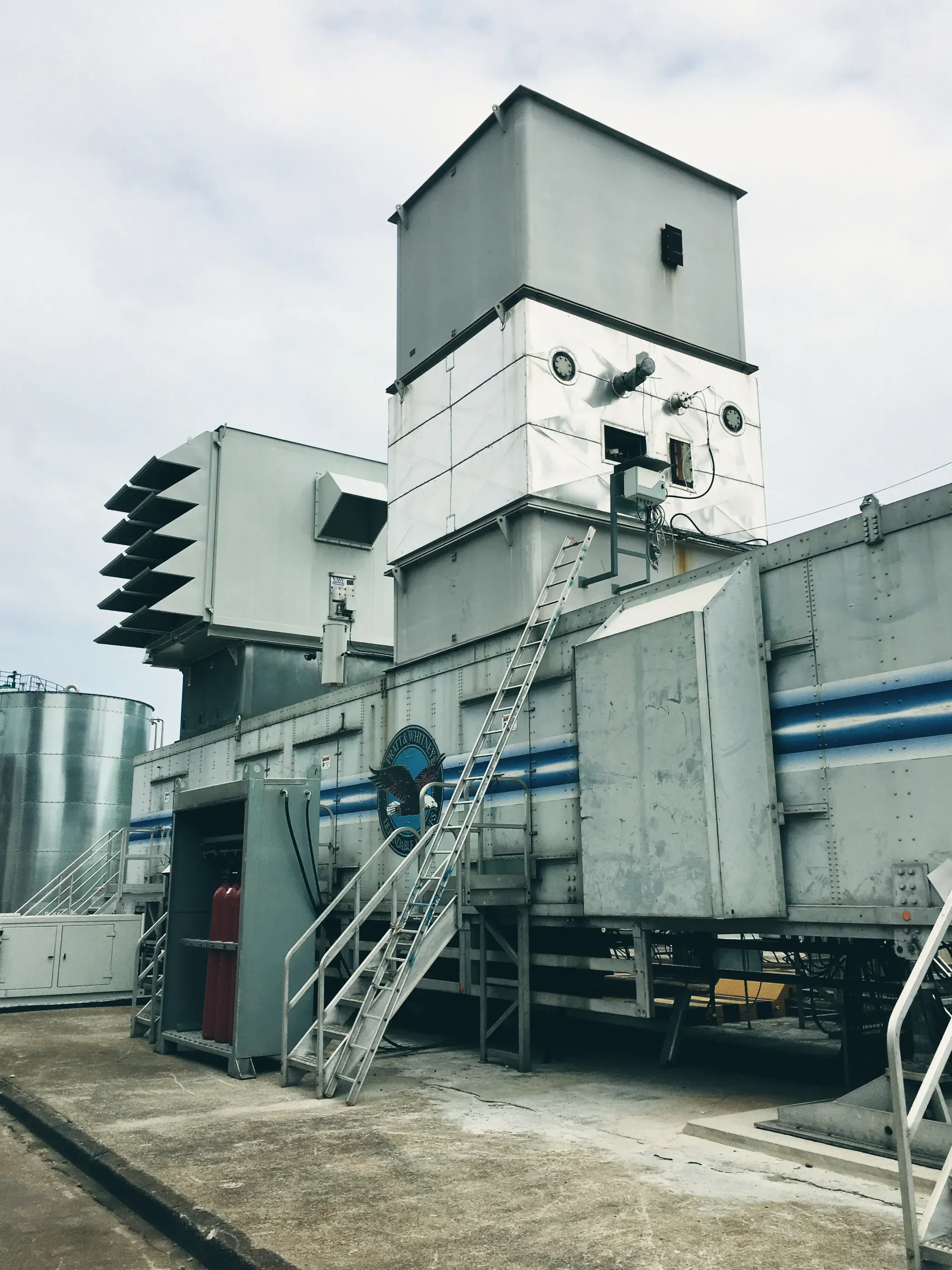
Legacy equipment, mixed makes, remote sites
Your machines weren’t designed to communicate. Mobapi gets them talking.
Turbines on their second or third life, older-generation control systems, PLCs from several manufacturers, tanks with no connected sensors: plenty of operators run a fleet like this. Mobapi monitors it as it stands, on a single dashboard, even at a remote site.
Mobapi is an industrial monitoring platform that reads GE Mark VIe and Woodward Micronet turbine control systems, and brings them together on a single screen with PLCs and operator round readings. Mobapi has also read a GE Speedtronic Mark IV from its printer output.
One fleet, several generations, no overview.
A production site is built up in layers. A turbine installed thirty years ago, a genset added later, a PLC replaced last year. Each piece of equipment comes with its own software, its own network and its own manufacturer. The oldest ones don’t even have a network port.
Protocols that don’t talk to each other: serial, OPC, Modbus, 4-20 mA signals.
Control networks that must stay cut off from the internet.
Remote sites on fragile links, sometimes with no network at all.
Readings written down by hand, which never make it into your systems.
No one sees the whole picture. And the oldest assets, often the most fragile, are the ones you see least.
A layer of intelligence on top of what you have.
The Mobapi.BOX connects to what is already in place and reads each piece of equipment in its own protocol. Read-only by design: the BOX sends no commands to your equipment. Mobapi then adds what was missing: thresholds and alarms, a time-stamped history, a shared view across all sites, and round readings in the same place.

Three generations of control systems, one screen.
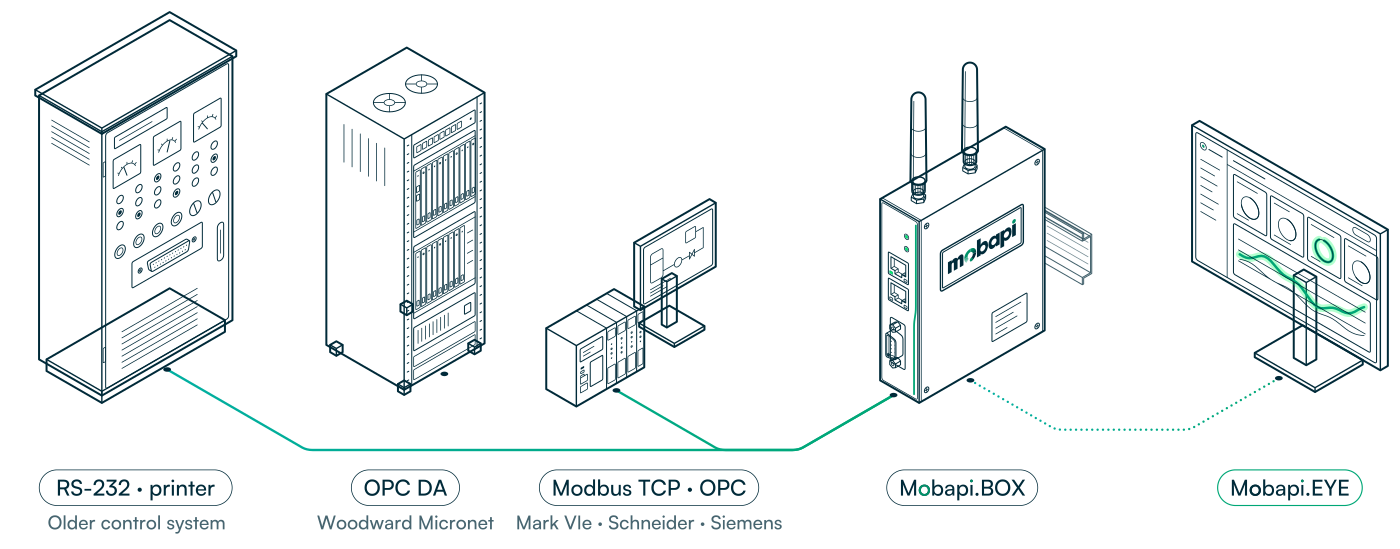
A Mark IV that only talked to its printer, Micronet controllers whose network stays cut off from the internet, today’s PLCs: Mobapi has connected them all to a single screen.
Control systems already connected.
The control systems below were all connected for the same thermal power plant operator, on the same platform. Digital rounds came next.
-
GE Speedtronic Mark IV
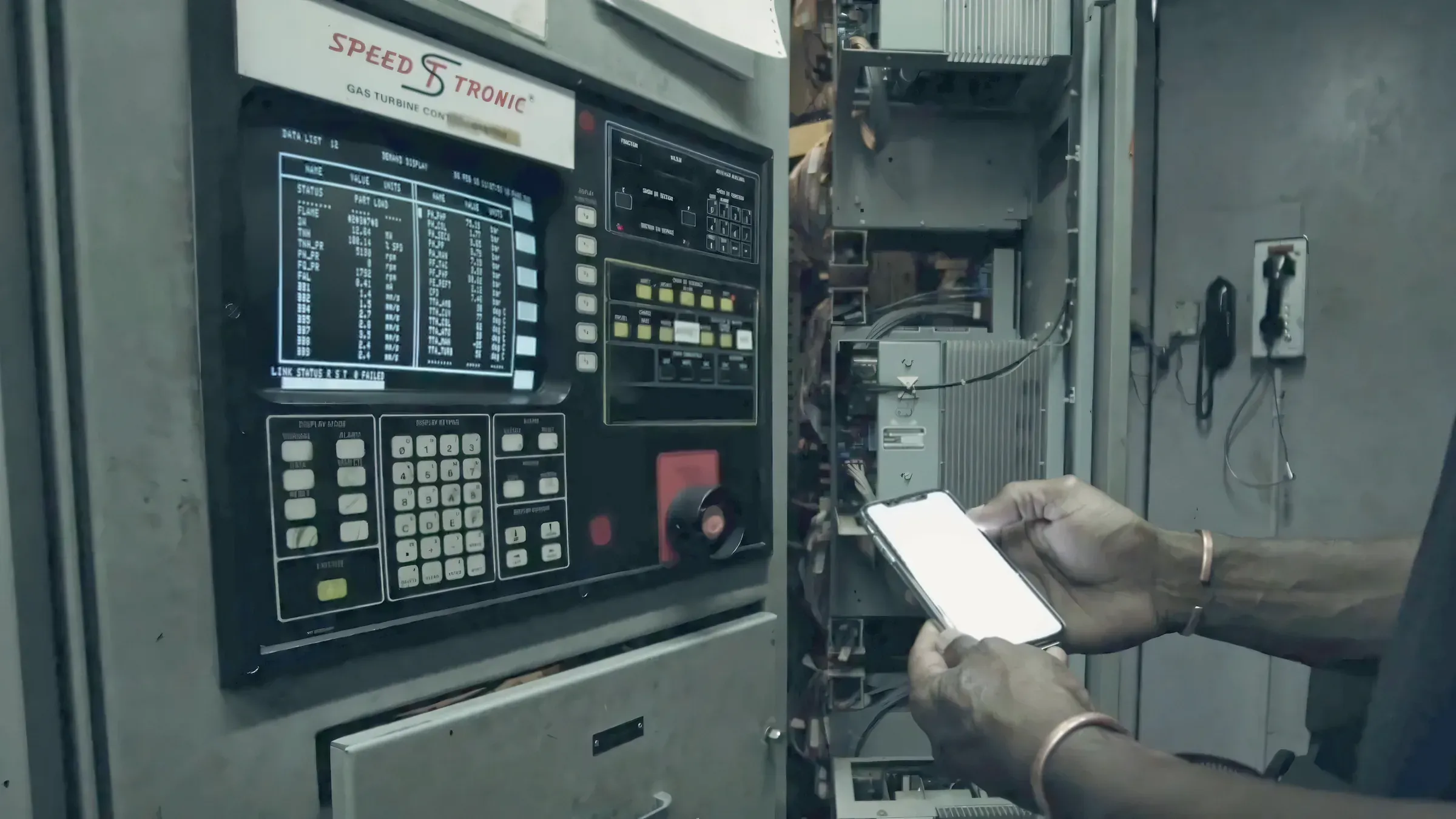
The control system fitted to GE turbines in the 1980s. It had no network port and no network expansion card, but it regularly sent its status to a dot-matrix printer. Mobapi connected the BOX to the printer output, with a splitter on the printer port. The BOX decoded the signals meant for the printer and turned them into data, filed and classified like sensor measurements. The control system was not modified. Mobapi read it this way until it was migrated to a Mark VIe, and the connection had taken under five months, from feasibility study to delivery. Read the Mark IV story
Printer output
-
GE Mark VIe
The current generation of GE control systems, part of the Mark VI family. Mobapi reads it over Modbus TCP, or through the OPC DA server on the HMI.
Modbus TCP or OPC DA
-
Woodward Micronet
The controller on many aeroderivative turbines, in this case a Pratt & Whitney turbine and a GE TM2500+. Its native protocols give write access to its settings, so Mobapi goes through an OPC DA server instead, read-only. The gateway separates two networks, and the control network stays cut off from the internet.
OPC DA
-
Schneider Modicon, with Codra Panorama SCADA
The PLCs of the diesel gensets. Mobapi reads their data over OPC DA, through the SCADA already in place.
OPC DA
-
Siemens S7, with PCS 7 and WinCC
The PLCs of the flue gas treatment unit, on a network separate from the gensets’ network. Read over OPC DA from WinCC. The two networks stay separate; Mobapi brings them together on screen.
OPC DA
-
ComAp genset controllers
At a small, remote power plant, Mobapi reads the controllers over Modbus and the tank level probes through their 4-20 mA output. Everything is sent over 3G/4G.
Modbus, 4-20 mA, 3G/4G
-
Analogue 4-20 mA sensors
On fuel oil tanks, probes that only displayed their readings locally. A converter turns them into Modbus TCP, and the BOX sends them over 3G/4G. Levels are displayed continuously, with a high-level alarm before any overflow.
4-20 mA, converted to Modbus TCP
-
Paper-based rounds and shift logs
Readings written down by hand are entered on a phone, even with no network, then join the fleet’s history. At this plant operator, shift logs went digital before rounds.
Entered on a phone

Your system isn’t on the list? We build the connector.


Turbines on their second or third life.
A gas turbine runs for decades. It sometimes changes site or owner, and often its control system. The operator keeps the turbine, and with it systems that hardly anyone still knows.
Mobapi monitors them like any other. When the control system changes, we change the connector, and the turbine stays on the same screen. It has already happened on a turbine migrated from a Mark IV to a Mark VIe: Mobapi read the old system’s printer output, then the new one’s Modbus TCP.
The same turbine, on the same screen
Before
Mark IV
read from its printer output
After
Mark VIe
read over Modbus TCP
Born before the internet. Read by Mobapi.
“When an Irish turbine specialist travels all this way to see a 1980s Mark IV send its data, you know you’re onto something.”
A representative of OFS, an Irish turbine operations and maintenance specialist, came to see how Mobapi extracted data from a Mark IV with no network expansion card.
- Mobapi presented its approach to a panel of oil & gas industry players in the United States.
- Mobapi took part in the UAE-France Energy Days in the United Arab Emirates.
Use cases.
Scenarios built from capabilities already deployed in production. They are not customer references.
-
Use case
A turbine on its third life, with a Mark IV
An old turbine, still in service, with no network port. Mobapi reads what the control system sends to its printer, without modifying it, and sets alarms on the key measurements.
Based on the Mark IV that Mobapi connected.
-
Use case
An offshore platform with aeroderivative turbines
The platform’s power comes from turbines run by Woodward controllers, and the onshore team has no visibility. Mobapi reads the controllers over OPC DA, on a gateway between two separate networks, and sends the measurements to a shared screen onshore.
Based on Woodward controllers read at onshore sites.
-
Use case
A remote diesel power plant
A few gensets, some tanks, few staff, a fragile link. Mobapi reads the genset controllers over Modbus, converts the tank probes and sends everything over 3G/4G. If the link drops, the BOX keeps the measurements.
Based on a remote plant that is already connected.
-
Use case
A tank farm with no connected sensors
Analogue sensors that only show their readings on site. Mobapi converts their signal, tracks levels continuously and alerts the control room before an overflow.
Based on fuel oil tanks connected to the BOX.
-
Use case
Paper-based rounds that join the system
Operators write values into paper logbooks that are rarely looked at again. With Mobapi, they enter them on a phone, along a predefined route, and the readings are filed with the automatic measurements.
Based on digital rounds in production.
-
Use case
A hydroelectric dam
The plant’s output, the reservoir level probes and weather sensors around the dam. Mobapi reads the meters, connects the probes over 4-20 mA and sends everything over 3G/4G or LoRaWAN, onto the same screen as the rest of the fleet.
Based on 4-20 mA sensors and 3G/4G, already in service.
Where fleets are at their most mixed.
- Remote sites
- Power plants serving remote communities, stations miles from anywhere. The BOX runs over 3G/4G and keeps months of measurements if the link drops.
- Offshore and oil & gas
- Aeroderivative turbines and scattered equipment, far from onshore teams. The control network must stay isolated, and the BOX works read-only.
- Island and non-interconnected grids
- Every generation outage affects the whole grid. Mobapi has been working on a non-interconnected power grid since 2017.
- Emerging markets
- Utilities whose power plants are spread across outlying regions, with modern generation assets alongside older ones.
The enquiries we have received come from island grids, utilities in developing countries and oil & gas players.

Frequently asked questions.
Can Mobapi monitor legacy equipment with no network port?
Yes. Mobapi has already connected a GE Speedtronic Mark IV control system that had no network port. The BOX read what it sent to its printer, without changing anything in the control system. It also reads serial links (RS-232). When a piece of equipment transmits nothing, we add sensors (4-20 mA, digital inputs) connected to the BOX.
How do you monitor a GE Speedtronic Mark IV with no network port?
From its printer output, without modifying the control system. The Mark IV that Mobapi connected had no network port, but it sent its status to a dot-matrix printer. A splitter gave the BOX a copy, and the BOX decoded those signals and filed them like sensor measurements. The connection had taken under five months.
Do we need to modify the control system or the PLCs?
No. The Mobapi.BOX connects read-only, by design: the BOX sends no commands to your equipment. Your program and your settings stay the same.
Our turbines are run by Woodward controllers or by a Mark VIe. Is that compatible?
Yes. Mobapi reads Woodward Micronet controllers over OPC DA, on Pratt & Whitney and GE aeroderivative turbines, and the GE Mark VIe over Modbus TCP or OPC DA. Each turbine appears on the same screen as the rest of the fleet.
How do you monitor a legacy control system that has no network port?
By reading what it already sends out, or by measuring alongside it. An older machine almost always talks a little: a serial link, an output to a printer. When it transmits nothing, sensors are added on the outside, leaving its program alone. Mobapi read a GE Speedtronic Mark IV this way, from its printer output.
How do you monitor a remote industrial site with unreliable connectivity?
You need a unit that collects on site and keeps its measurements when the link drops. At a site kept off the company network, the link runs over the mobile network, 3G/4G, with its own SIM card. Mobapi’s BOX keeps several months of measurements this way, then sends them once the network is back.
Does Mobapi work at a remote site or offshore?
At a remote site, yes: the BOX runs over 3G/4G, keeps several months of measurements if the link goes down, then sends them once the network is back. Offshore, the constraints are the same (isolated control network, fragile link). Our deployments to date are onshore.
Is there vendor-independent monitoring for aeroderivative turbines offshore?
Yes, provided it connects to the turbine controller read-only and leaves the control network cut off from the internet. Many aeroderivative turbines are run by a Woodward Micronet controller. Mobapi, which is not tied to any manufacturer, reads it through an OPC DA server, on a gateway between two separate networks. Its deployments to date are onshore.
Can we bring in manual readings from rounds?
Yes. Your teams enter their readings on a phone, along a route prepared in advance. The readings join the equipment history and can be viewed on the same screens. Readings already kept in a CSV or Excel file can be imported too.
Your oldest asset? Send us its model number.
Make, model, year if you have it, and a photo of the nameplate. We’ll tell you what Mobapi can get out of it, and how. If a connector is missing, we’ll build it.